




Label: BLUE NOTE
No.: BLP 4080
Title: WORKOUT
Musician: HANK MOBLEY
Recorded: 1961/3/26
Monaural
Cover address: 43 West 61st St, New York 23, INC
Laminate Coating
Groove Guard
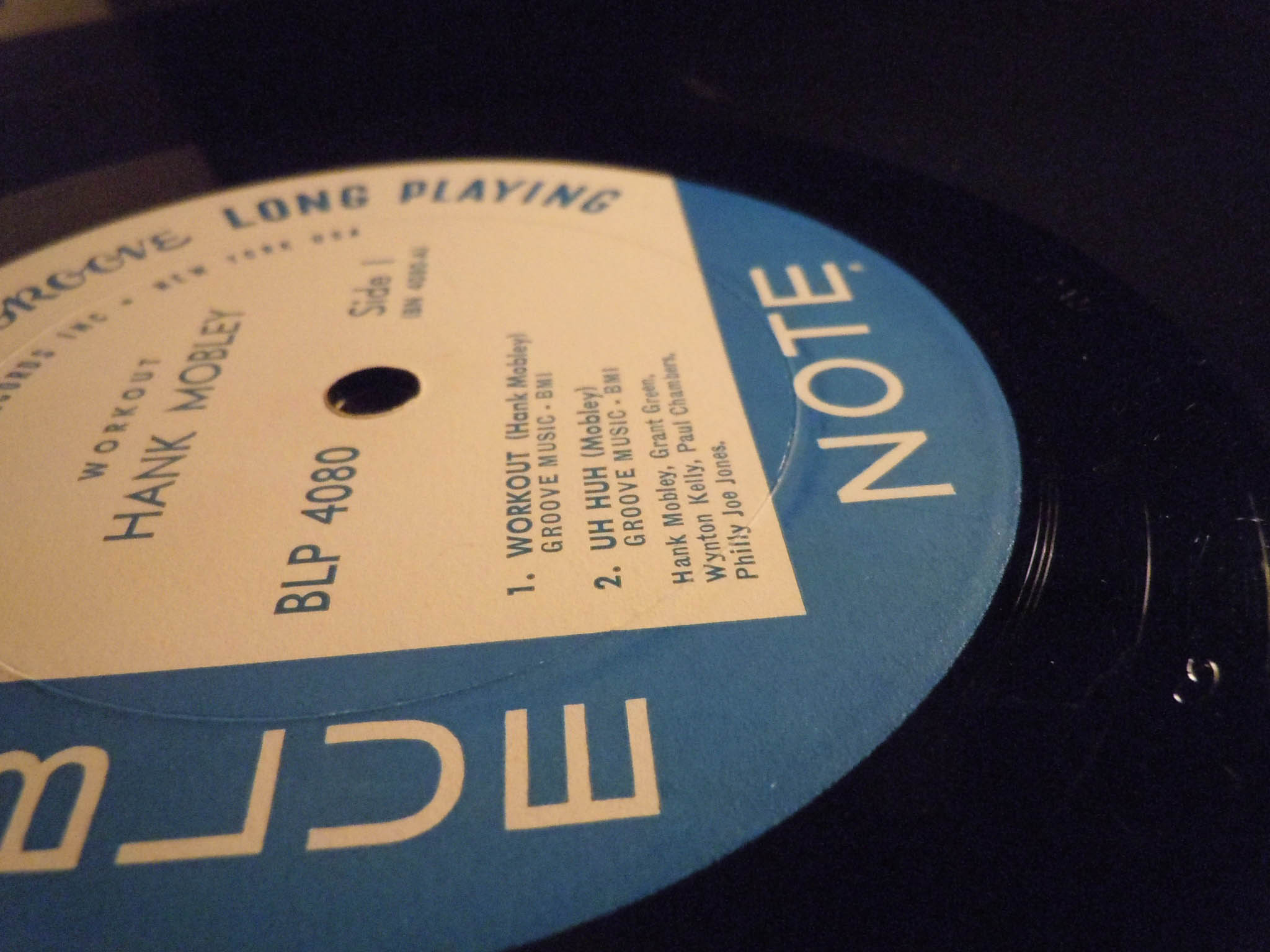
Label Side-1
Blue & White Background
White & Blue Letter, INC&R
Address: NEW YORK USA
Deep Groove無し
Dead Wax Info: RVGスタンプ, BN-LP-4080-A, P(Ear), 1dot
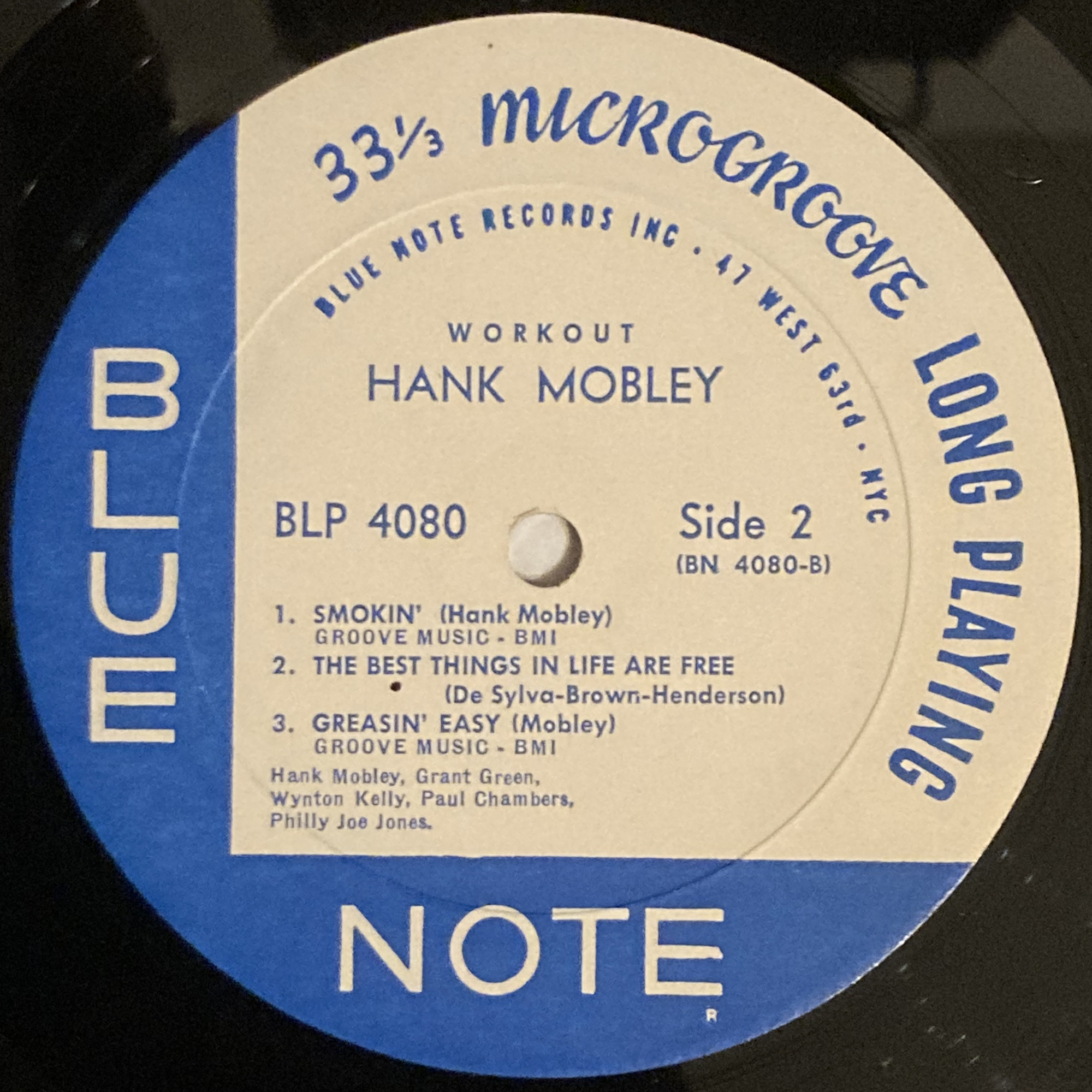
Label Side-2
Blue & White Background
White & Blue Letter, INC&R
Address: 47 WEST 63rd, NYC
Deep Groove無し
Dead Wax Info: RVGスタンプ, BN-LP-4080-B, P(Ear), 1dot
Personnel-
Drums: Philly Joe Jones
Bass: Paul Chambers
Piano: Wynton Kelly
Tenor Sax: Hank Mobley
Guitar: Grant Green
Tracks-
Side-1
1) Workout 10’00”
2) Uh Huh 10’45”
Side-2
1) Smokin’ 7’28”
2) The Best Things in Life are Free 5’16”
3) Greasin’ Easy 6’59”
Frederick Cohen氏のBlue Noteガイドブック情報ではSide1が63rd,Side2がNYCが
オリジナルで、未確認情報として本ページ掲載盤と同じSide1がNYC,Side2が63rd(但しPマーク無し)が記載されています。本ページ掲載盤は両面ともにPマークがあります。
別の情報によると両面63rdも存在するそうです。
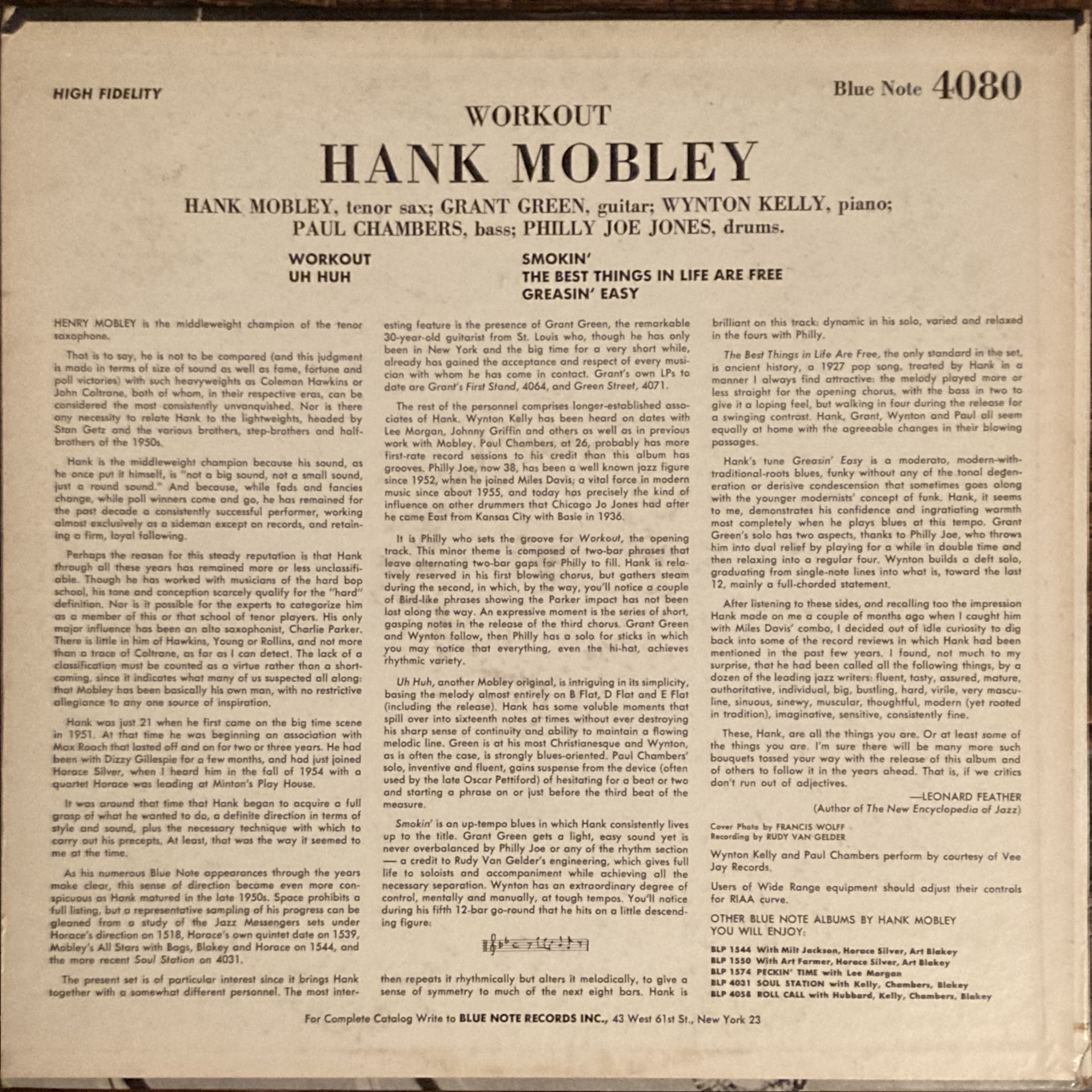
<裏ジャケ原文>
HENRY MOBLEY is the middleweight champion of the tenor saxophone.
That is to say, he is not to be compared (and this judgment is made in terms of size of sound as well as fame, fortune and poll victories) with such heavyweights as Coleman Hawkins or John Coltrane, both of whom, in their respective eras, can be considered the most consistently unvanquished. Nor is there any necessity to relate Hank to the lightweights, headed by Stan Getz and the various brothers, step-brothers and half- brothers of the 1950s.
Hank is the middleweight champion because his sound, as he once put it himself, is “not a big sound, not a small sound, just a round sound.” And because, while fads and fancies change, while poll winners come and go, he has remained for the past decade a consistently successful performer, working almost exclusively as a sideman except on records, and retain- ing a firm, loyal following.
Perhaps the reason for this steady reputation is that Hank through all these years has remained more or less unclassifi- able. Though he has worked with musicians of the hard bop school, his tone and conception scarcely qualify for the “hard” definition. Nor is it possible for the experts to categorize him as a member of this or that school of tenor players. His only major influence has been an alto saxophonist, Charlie Parker. There is little in him of Hawkins, Young or Rollins, and not more than a trace of Coltrane, as far as I can detect. The lack of a classification must be counted as a virtue rather than a short- coming, since it indicates what many of us suspected all along: that Mobley has been basically his own man, with no restrictive allegiance to any one source of inspiration.
Hank was just 21 when he first came on the big time scene in 1951. At that time he was beginning an association with Max Roach that lasted off and on for two or three years. He had been with Dizzy Gillespie for a few months, and had just joined Horace Silver, when I heard him in the fall of 1954 with a quartet Horace was leading at Minton’s Play House.
It was around that time that Hank began to acquire a full grasp of what he wanted to do, a definite direction in terms of style and sound, plus the necessary technique with which to carry out his precepts. At least, that was the way it seemed to me at the time.
As his numerous Blue Note appearances through the years make clear, this sense of direction became even more con- spicuous as Hank matured in the late 1950s. Space prohibits a full listing, but a representative sampling of his progress can be gleaned from a study of the Jazz Messengers sets under Horace’s direction on 1518, Horace’s own quintet date on 1539, Mobley’s All Stars with Bags, Blakey and Horace on 1544, and the more recent Soul Station on 4031.
The present set is of particular interest since it brings Hank together with a somewhat different personnel. The most interesting feature is the presence of Grant Green, the remarkable 30-year-old guitarist from St. Louis who, though he has only been in New York and the big time for a very short while, already has gained the acceptance and respect of every musi- cian with whom he has come in contact. Grant’s own LPs to date are Grant’s First Stand, 4064, and Green Street, 4071.
The rest of the personnel comprises longer-established asso- ciates of Hank. Wynton Kelly has been heard on dates with Lee Morgan, Johnny Griffin and others as well as in previous work with Mobley. Paul Chambers, at 26, probably has more first-rate record sessions to his credit than this album has grooves. Philly Joe, now 38, has been a well known jazz figure since 1952, when he joined Miles Davis; a vital force in modern music since about 1955, and today has precisely the kind of influence on other drummers that Chicago Jo Jones had after he came East from Kansas City with Basie in 1936.
It is Philly who sets the groove for Workout, the opening track. This minor theme is composed of two-bar phrases that leave alternating two-bar gaps for Philly to fill. Hank is rela- tively reserved in his first blowing chorus, but gathers steam during the second, in which, by the way, you’ll notice a couple of Bird-like phrases showing the Parker impact has not been lost along the way. An expressive moment is the series of short, gasping notes in the release of the third chorus. Grant Green and Wynton follow, then Philly has a solo for sticks in which you may notice that everything, even the hi-hat, achieves rhythmic variety.
Uh Huh, another Mobley original, is intriguing in its simplicity, basing the melody almost entirely on B Flat, D Flat and E Flat (including the release). Hank has some voluble moments that spill over into sixteenth notes at times without ever destroying his sharp sense of continuity and ability to maintain a flowing melodic line. Green is at his most Christianesque and Wynton, as is often the case, is strongly blues-oriented. Paul Chambers’ solo, inventive and fluent, gains suspense from the device (often used by the late Oscar Pettiford) of hesitating for a beat or two and starting a phrase on or just before the third beat of the
measure.
Smokin’ is an up-tempo blues in which Hank consistently lives up to the title. Grant Green gets a light, easy sound yet is never overbalanced by Philly Joe or any of the rhythm section
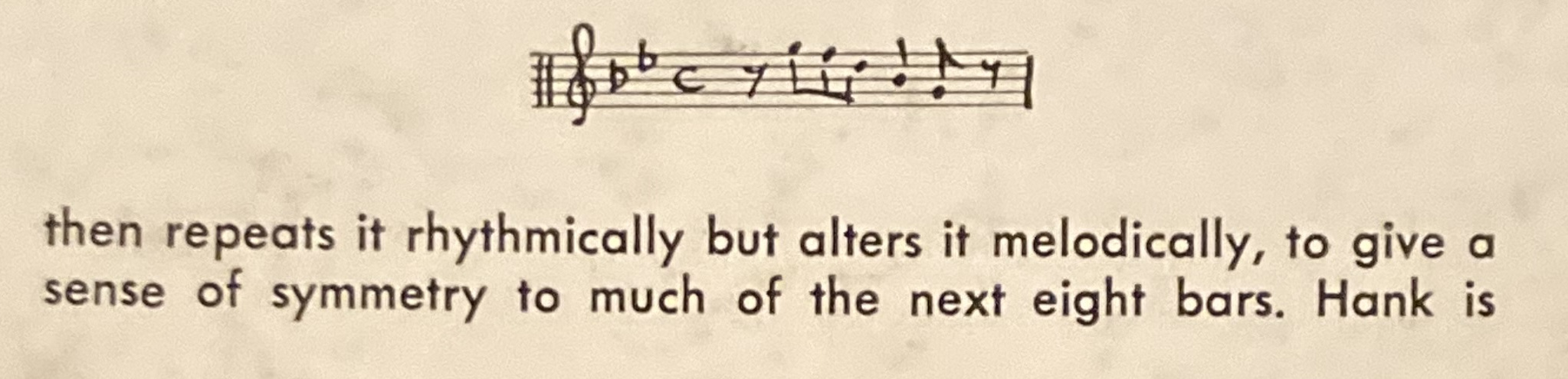
a credit to Rudy Van Gelder’s engineering, which gives full life to soloists and accompaniment while achieving all the necessary separation. Wynton has an extraordinary degree of control, mentally and manually, at tough tempos. You’ll notice during his fifth 12-bar go-round that he hits on a little descend- ing figure:
then repeats it rhythmically but alters it melodically, to give a sense of symmetry to much of the next eight bars. Hank is brilliant on this track: dynamic in his solo, varied and relaxed in the fours with Philly.
The Best Things in Life Are Free, the only standard in the set, is ancient history, a 1927 pop song, treated by Hank in a manner I always find attractive: the melody played more or less straight for the opening chorus, with the bass in two to give it a loping feel, but walking in four during the release for a swinging contrast. Hank, Grant, Wynton and Paul all seem equally at home with the agreeable changes in their blowing passages.
Hank’s tune Greasin’ Easy is a moderato, modern-with- traditional-roots blues, funky without any of the tonal degen- eration or derisive condescension that sometimes goes along with the younger modernists’ concept of funk. Hank, it seems. to me, demonstrates his confidence and ingratiating warmth most completely when he plays blues at this tempo. Grant Green’s solo has two aspects, thanks to Philly Joe, who throws him into dual relief by playing for a while in double time and then relaxing into a regular four. Wynton builds a deft solo, graduating from single-note lines into what is, toward the last 12, mainly a full-chorded statement.
After listening to these sides, and recalling too the impression Hank made on me a couple of months ago when I caught him with Miles Davis’ combo, I decided out of idle curiosity to dig back into some of the record reviews in which Hank had been mentioned in the past few years. I found, not much to my surprise, that he had been called all the following things, by a dozen of the leading jazz writers: fluent, tasty, assured, mature, authoritative, individual, big, bustling, hard, virile, very mascu- line, sinuous, sinewy, muscular, thoughtful, modern (yet rooted in tradition), imaginative, sensitive, consistently fine.
These, Hank, are all the things you are. Or at least some of the things you are. I’m sure there will be many more such bouquets tossed your way with the release of this album and of others to follow it in the years ahead. That is, if we critics don’t run out of adjectives.
-LEONARD FEATHER
(Author of The New Encyclopedia of Jazz)
Cover Photo by FRANCIS WOLFF. Recording by RUDY VAN GELDER
Wynton Kelly and Paul Chambers perform by courtesy of Vee Jay Records.
Users of Wide Range equipment should adjust their controls for RIAA curve.
OTHER BLUE NOTE ALBUMS BY HANK MOBLEY YOU WILL ENJOY:
BLP 1544 With Milt Jackson, Horace Silver, Art Blakey BLP 1550 With Art Farmer, Horace Silver, Art Blakey
BLP 1574 PECKIN’ TIME with Lee Morgan
BLP 4031 SOUL STATION with Kelly, Chambers, Blakey
BLP 4058 ROLL CALL with Hubbard, Kelly, Chambers, Blakey
<裏ジャケ和訳>
ヘンリー・モブリーは、テナー・サックス界における「ミドル級チャンピオン」である。
つまり、彼はコールマン・ホーキンスやジョン・コルトレーンといった「ヘビー級」の巨匠たち――それぞれの時代において、常に不動の王者と見なされてきた二人――と比較されるような存在ではない、ということだ。かといって、スタン・ゲッツや、1950年代に数多く登場した「兄弟(ブラザーズ)」系譜の奏者たちに代表される「ライト級」の連中と関連づける必要もない。
彼がミドル級チャンピオンである理由は、そのサウンドにある。彼自身がかつて語ったように、それは「大きくもなく、小さくもなく、ただ丸みのある(ラウンドな)サウンド」なのだ。そして、流行や嗜好が移ろい、人気投票の勝者が次々と入れ替わる中で、彼はこの10年間、一貫して成功を収める演奏家であり続けたからでもある。彼はレコード制作以外ではほぼ専らサイドマンとして活動し、確固たる熱心なファン層を維持してきた。
こうした安定した評価の理由は、おそらく、彼が長年にわたり「これ」といった特定のカテゴリーに当てはまらない存在であり続けたことにあるのだろう。ハード・バップ派のミュージシャンたちと共演してはきたが、彼のトーンや音楽的発想は、「ハード(硬質)」という定義には当てはまらない。専門家であっても、彼をテナー・サックス奏者の特定の流派に分類することは不可能だ。彼が受けた唯一の大きな影響は、アルト・サックス奏者のチャーリー・パーカーによるものだけである。ホーキンス、ヤング、あるいはロリンズといった奏者の要素はほとんど見当たらないし、コルトレーンの影響も、私が見る限りごくわずかな痕跡がある程度だ。特定の分類に収まらないことは、欠点ではなく美点と見なすべきだろう。なぜならそれは、我々の多くが以前から感じていたことを裏付けているからだ。つまり、モブリーは特定のインスピレーション源に縛られることなく、あくまで自分自身のスタイルを貫いてきたということである。
1951年、ヘンリー・モブリーが音楽シーンの表舞台に登場したとき、彼はまだ21歳だった。当時、彼はマックス・ローチとの共演を始めたばかりで、その関係はその後2、3年にわたって断続的に続いた。ディジー・ガレスピーのバンドに数ヶ月在籍し、ホレス・シルバーのグループに加わったばかりの頃――1954年の秋のことだが――私はミントンズ・プレイハウスで、ホレスが率いるカルテットの一員として演奏する彼の姿を耳にした。ハンクが自分のやりたいこと、つまりスタイルやサウンドにおける明確な方向性をしっかりと把握し、さらにその信念を具現化するために必要なテクニックを身につけ始めたのは、ちょうどその頃のことでした。少なくとも、当時の私にはそう見えました。
長年にわたる数多くのブルーノートでの録音が物語るように、1950年代後半にハンクが成熟するにつれて、この方向性はより一層際立ったものとなりました。紙幅の都合上すべてを挙げることはできませんが、彼の歩みを示す代表的な例としては、ホレスの指揮によるジャズ・メッセンジャーズの作品(1518番)、ホレス自身のクインテット作品(1539番)、モブレイ・オール・スターズ(バグス、ブレイキー、ホレス参加の1544番)、そしてより新しい『ソウル・ステーション』(4031番)などが挙げられます。
本作は、ハンクがこれまでとは少し異なる顔ぶれのメンバーと共演しているという点で、特に興味深い作品です。最も注目すべき点は、グラント・グリーンの参加でしょう。セントルイス出身のこの素晴らしい30歳のギタリストは、ニューヨークの第一線に出てきてまだ間もないにもかかわらず、共演したすべてのミュージシャンからすでに認められ、尊敬を集めています。グラント自身のリーダー作としては、これまでに『グラント・ファースト・スタンド』(4064番)と『グリーン・ストリート』(4071番)がリリースされています。
その他のメンバーは、ハンクと長年共演してきた馴染みの顔ぶれです。ウィントン・ケリーは、モブレイとの過去の共演に加え、リー・モーガンやジョニー・グリフィンらのセッションでもそのプレイを聴くことができます。ポール・チェンバースは26歳という若さですが、彼が参加した一流のレコーディング・セッションの数は、このアルバムの溝(グルーヴ)の数よりも多いと言えるほどでしょう。現在38歳のフィリー・ジョーは、1952年にマイルス・デイヴィスのバンドに加入して以来、ジャズ界の著名な人物として知られています。1955年頃からはモダン・ミュージックにおける重要な推進力となり、今日では、1936年にカンザス・シティからベイシーと共に東部へ出てきたシカゴのジョー・ジョーンズが他のドラマーに与えたのと同様の、決定的な影響を彼らにもたらしています。
オープニング・トラックである「ワークアウト」でグルーヴを作り出しているのは、このフィリーです。この副次的なテーマは2小節のフレーズで構成されており、その間にはフィリーが埋めるための2小節の空白が交互に設けられています。ハンクは最初のソロ・コーラスでは比較的控えめな演奏ですが、2回目のコーラスでは勢いを増していきます。ちなみに、その中には「バード(チャーリー・パーカー)」を彷彿とさせるフレーズがいくつか見られ、彼がパーカーの影響を失っていないことがうかがえます。3回目のコーラスのブリッジ(サビ)で見られる、息を呑むような短い音の連続は、表現力豊かな聴きどころの一つです。続いてグラント・グリーンとウィントンがソロをとり、その後にフィリーがスティックによるソロを披露します。ここでは、ハイハットを含めたあらゆる要素において、彼が多彩なリズムを表現していることに気づかされるでしょう。
「Uh Huh」はモブレイのオリジナル曲で、そのシンプルさが興味をそそります。メロディは(ブリッジ部分を含め)ほぼ全面的にB♭、D♭、E♭の3音を基調としています。ハンクは時に16分音符を交えて饒舌に演奏しますが、鋭い連続性や流麗なメロディ・ラインを保つ能力が損なわれることは決してありません。グリーンは最もクリスチャン(チャーリー・クリスチャン)らしいプレイを見せ、ウィントンはいつものように、強いブルース志向の演奏を繰り広げます。ポール・チェンバースのソロは独創的かつ流麗で、1〜2拍「ため」を作り、小節の3拍目(あるいはその直前)からフレーズを開始するという手法(故オスカー・ペティフォードが多用したものです)によって、演奏にサスペンス(緊張感)を生み出しています。
「Smokin’」はアップテンポのブルースで、ハンクはそのタイトルに違わぬ熱い演奏を終始展開します。グラント・グリーンは軽やかで伸びやかな音色を聴かせますが、フィリー・ジョーや他のリズム・セクションの音量に圧倒されることはありません。これはルディ・ヴァン・ゲルダーのエンジニアリングの賜物であり、必要な楽器の分離を確保しつつ、ソリストと伴奏の双方を生き生きと響かせています。ウィントンは、難易度の高いテンポにおいても、精神的・技術的に驚くべきコントロール力を発揮しています。12小節のコーラスを5回繰り返す中で、彼がある下降フレーズを弾くことに気づくでしょう。
彼はそのフレーズをリズム的には反復しつつメロディを変化させ、続く8小節の大部分にシンメトリー(対称性)の感覚を与えています。このトラックでのハンクは素晴らしいの一言に尽きます。ソロではダイナミックであり、フィリーとの「4バース・トレード」では変化に富みつつもリラックスしたプレイを見せています。
本作唯一のスタンダード・ナンバーである「The Best Things in Life Are Free」は、1927年のポップ・ソングという古い曲ですが、ハンクは私がいつも魅力を感じるアプローチで演奏しています。冒頭のコーラスではメロディをほぼストレートに演奏し、ベースは2ビートでゆったりとした足取り(ローピング・フィール)を生み出しますが、ブリッジ部分では4ビートのウォーキング・ベースに切り替え、スウィング感のある対比を作り出しています。ハンク、グラント、ウィントン、ポールは皆、こうした心地よい展開の中で、等しく伸び伸びと演奏しているようです。
ハンクの自作曲「Greasin’ Easy」はモデラート・テンポのブルースで、伝統に根ざしつつもモダンな響きを持っています。若手のモダニストが抱く「ファンク」の概念に伴いがちな、音色の質の低下や、冷笑的な見下しといった要素とは無縁の、純粋にファンキーな楽曲です。ハンクは……彼がこのテンポでブルースを演奏する時、その自信と、聴き手を心地よく包み込むような温かさが最も如実に表れていると私は感じます。グラント・グリーンのソロには二つの側面があります。それはフィリー・ジョーの巧みなドラミングのおかげです。彼はしばらくダブル・タイム(倍の速さ)で演奏した後、通常の4ビートへと落ち着くことで、グリーンのソロの対比を際立たせているのです。ウィントンは巧みなソロを展開し、単音のラインから徐々に変化して、最後の12小節あたりでは主にフル・コード(和音)を駆使した演奏へと移行していきます。
これらの演奏を聴き、さらに数ヶ月前にマイルス・デイヴィスのコンボでハンクの演奏を聴いた時の印象を思い出しながら、ふとした好奇心から、過去数年間にハンクについて書かれたレコード評を読み返してみることにしました。案の定というか、驚くことではありませんが、彼は多くの主要なジャズ評論家たちから次のような言葉で評されていました――流麗、味わい深い、確信に満ちた、円熟した、堂々とした、個性的な、スケールの大きな、活気ある、ハードな、精悍な、極めて男らしい、しなやかな、力強い、筋肉質な、思慮深い、モダン(かつ伝統に根ざした)、想像力豊かな、繊細な、そして常に素晴らしい。
ハンク、これらすべてが「あなた」という存在なのです。あるいは、少なくともその一部と言えるでしょう。このアルバムや、今後リリースされるであろう作品を通じて、あなたにはさらに多くの賛辞が寄せられることでしょう。もっとも、私たち評論家の手持ちの形容詞が尽きてしまわなければの話ですが。
- レナード・フェザー
(『The New Encyclopedia of Jazz』著者)
カバー写真:フランシス・ウルフ 録音:ルディ・ヴァン・ゲルダー
ウィントン・ケリーとポール・チェンバースはVee Jay Recordsの好意により参加しています。
ワイドレンジ対応の機器をお使いの場合は、RIAAカーブに合わせてコントロールを調整してください。
ハンク・モブレイの他のブルーノート・アルバム(おすすめ作品):
BLP 1544 ミルト・ジャクソン、ホレス・シルバー、アート・ブレイキーとの共演
BLP 1550 アート・ファーマー、ホレス・シルバー、アート・ブレイキーとの共演
BLP 1574 『PECKIN’ TIME』(リー・モーガンとの共演)
BLP 4031 『SOUL STATION』(ケリー、チェンバース、ブレイキーとの共演)
BLP 4058 『ROLL CALL』(ハバード、ケリー、チェンバース、ブレイキーとの共演)
※訳文の制作にはGoogleドライブとGoogle翻訳のお世話になりました。
コメント